A common mistake on Santa Clarita projects is treating all anchors the same. A tieback for a shoring wall along the San Francisquito Creek floodplain faces different demands than a passive rock bolt in the Saugus Formation. The soil-structure interaction changes completely when you move from the alluvial fans near the Santa Clara River to the steep cuts in Canyon Country. We see this weekly. Our anchor design approach starts with a detailed geotechnical profile from SPT drilling to avoid overestimating bond stress in cemented silts, then we size the unbonded length based on the actual failure wedge geometry defined in site-specific slope stability analysis. No generic tables. The 1994 Northridge earthquake reminded every engineer in this valley that anchor ductility matters as much as ultimate capacity, and we carry that lesson into every submittal.
An anchor is only as reliable as the ground it's bonded to. We prove the bond before we trust the design.
Technical details of the service in Santa Clarita
- Bond length calculated by limit equilibrium methods, verified with field pull-out tests.
- Unbonded length extended beyond the critical failure surface per FHWA guidelines.
- Lock-off load set at 70 percent of design load to allow for relaxation without loss of serviceability.
- Corrosion protection Class II minimum for permanent anchors in aggressive soil with sulfate concentrations above 0.1 percent.
- Acceptance criteria: creep rate under 2 mm per log cycle of time during performance testing.
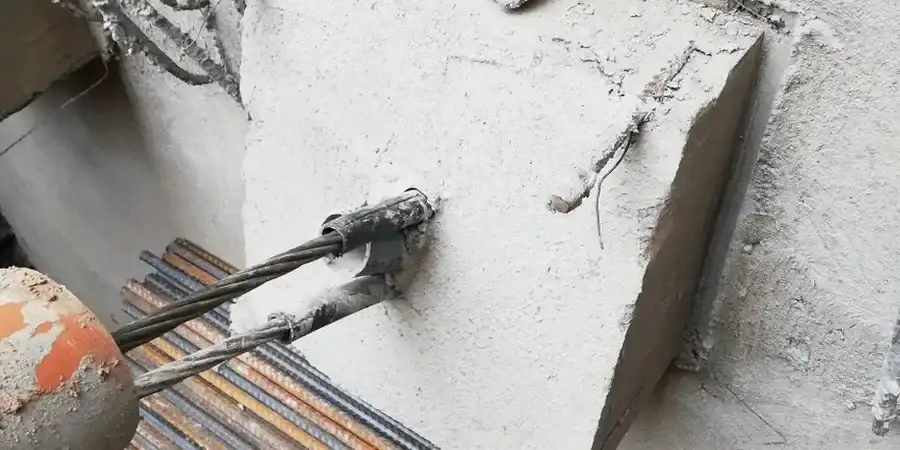
Local geotechnical conditions in Santa Clarita
A deep excavation on McBean Parkway hit groundwater at 18 feet. The original design called for active anchors with a 20-foot bond zone. Our review of the in-situ permeability data showed the water table fluctuates 6 feet seasonally. We revised the bond zone to start below the highest observed groundwater level and switched to a double-corrosion-protection system. The alternative was a progressive loss of bond stress as the saturated silt softened during the rainy season. That failure mode doesn't announce itself until the wall moves. In Santa Clarita, where the alluvial deposits alternate between well-drained gravels and impermeable silts, perched water is the rule, not the exception. A proof test on every anchor isn't just a code requirement; it's the only way to confirm the design assumptions hold at full scale.
Our services
We carry out anchor design as part of a complete shoring package. These operations work together on typical Santa Clarita projects.
Active Anchor Design
Tieback systems for soldier pile and secant pile walls. We size the tendon, design the bond zone, and specify lock-off procedures.
Passive Anchor Design
Rock bolts and soil nails for slope reinforcement and tunnel support in the Saugus Formation.
Load Testing & Verification
Performance tests, proof tests, and lift-off tests per PTI recommendations. We interpret the creep curves and sign off on acceptance.
Questions and answers
What does anchor design cost in Santa Clarita?
For a typical project, anchor design runs from US$1,050 to US$3,500 depending on the number of anchor types, the complexity of the subsurface profile, and the testing program required. A single-family lot retaining wall with 4 passive anchors sits at the lower end. A commercial excavation with 60 active tiebacks and performance testing on 5 anchors falls at the upper end.
How do you determine the bond length in the Saugus Formation?
We don't use presumptive values from a table. We correlate SPT N-values and triaxial test data from the specific boring to estimate the rock mass modulus, then calibrate the bond stress with a field pull-out test on a sacrificial anchor before production drilling starts.
What corrosion protection level do you specify for permanent anchors?
Class II minimum, per PTI DC35.1. In aggressive soil with sulfates or chlorides above threshold limits, or in fluctuating groundwater, we move to Class I with full encapsulation of the tendon in corrugated sheathing and controlled grout cover.