Santa Clarita sits on a complex mix of alluvial fans and older terrace deposits washed down from the San Gabriel and Santa Susana Mountains. The city's rapid expansion through the Santa Clara River Valley means engineers routinely encounter layered profiles where cohesive silts sit atop loose sands, and groundwater can appear within 15 feet of surface in lower watershed areas. Getting foundation design right here demands more than index testing; it requires precise shear strength data. The triaxial test remains the definitive method for determining the drained and undrained behavior of these soils. When we run consolidated-undrained triaxial tests with pore pressure measurement, the results feed directly into bearing capacity calculations and slope stability models. For a city with 229,000 residents and active development across zones mapped as liquefiable by the California Geological Survey, the difference between assumed and measured cohesion can translate into significant structural risk. Our laboratory works with undisturbed Shelby tube samples taken from depths up to 60 feet, applying confining pressures that replicate the actual overburden conditions beneath proposed footings. For deeper soil characterization, many projects combine this with CPT testing to establish continuous stratigraphy before selecting sampling depths.
Effective friction angles measured from CU triaxial testing on Santa Clarita alluvium typically range from 28 to 34 degrees, values that directly control foundation size and slope safety factors.
Technical details of the service in Santa Clarita
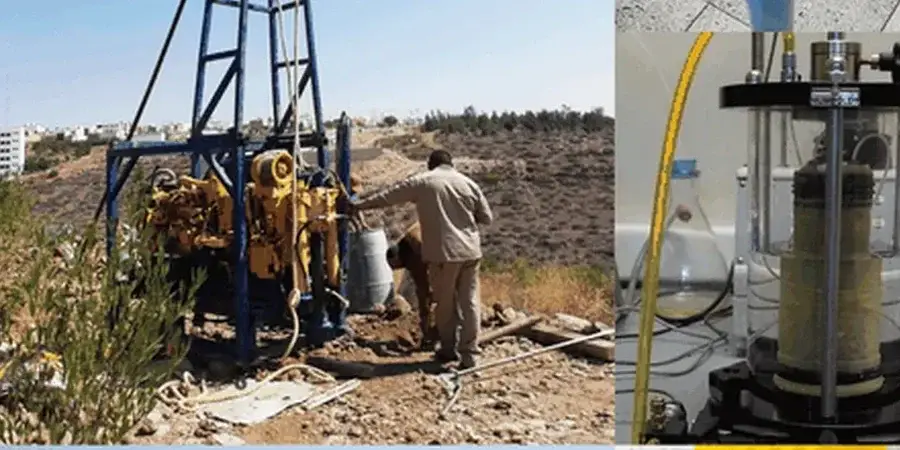
Local geotechnical conditions in Santa Clarita
The triaxial cell itself is a heavy-duty pressure chamber machined from stainless steel, with a transparent cylinder rated for 500 psi. A specimen membrane just a few millimeters thick separates the soil from the confining fluid, and a precision load cell mounted on the loading piston measures deviator stress to within 0.01 lb. In Santa Clarita, projects that skip proper triaxial testing on fine-grained alluvium often encounter a predictable pattern: the design assumes drained strength parameters from SPT correlations, but the actual soil behavior during rapid loading or earthquake shaking is undrained and significantly weaker. The 1994 Northridge earthquake demonstrated how saturated silts and sands in the valley can lose strength under cyclic loading, and post-earthquake investigations found cases where the static factor of safety was adequate but the dynamic response was not. A properly executed triaxial program with pore pressure measurement exposes this vulnerability before construction begins. For sites near the Santa Clara River where groundwater is shallow, undrained strength can be half or less of the drained value, a difference that changes everything about allowable bearing pressure and requires careful integration with liquefaction assessment protocols.
Our services
Every triaxial testing program in Santa Clarita is designed around the specific soil profile and structural demands of the project. The following operations cover the standard configurations requested for foundation and earthwork design in the region.
Consolidated-Undrained (CU) Triaxial with Pore Pressure Measurement
The most requested configuration for Santa Clarita projects. Three specimens are isotropically consolidated and sheared undrained at different effective confining pressures. Pore pressure transducers record excess pressure during shear, enabling effective stress analysis. Results carry out the effective cohesion intercept c' and effective friction angle φ' for long-term drained analysis, plus undrained shear strength Su for short-term loading cases. Suitable for saturated cohesive soils, compacted fill verification, and slope stability input.
Unconsolidated-Undrained (UU) Triaxial Testing
Used for rapid assessment of undrained shear strength in fine-grained soils. Specimens are sheared without consolidation, maintaining the in-situ moisture condition. While simpler than CU testing, UU results carry out Su values for preliminary foundation design and for checking the short-term stability of excavations in clayey soils. Often paired with Atterberg limits and moisture content profiles to interpret the results relative to soil plasticity.
Questions and answers
What sample quality is required for reliable triaxial test results in Santa Clarita soils?
Undisturbed samples are essential. We require Shelby tube samples with a minimum diameter of 3 inches, properly sealed and transported with minimal disturbance. For the silty and sandy alluvium common in Santa Clarita, samples should be taken in accordance with ASTM D1587 procedures, and the tubes must remain upright and protected from temperature extremes. Disturbed samples or bag samples are not suitable for triaxial testing. The sample recovery ratio and visual inspection of the tube ends before extrusion gives a first indication of quality, and specimens with visible fissures, gravel inclusions, or evidence of swelling are rejected before testing begins.
How much does triaxial testing cost for a typical Santa Clarita project?
A standard set of three CU triaxial tests with pore pressure measurement on undisturbed samples typically ranges from US$2,060 to US$2,850, depending on the number of specimens, the confining stress levels required, and whether the soil requires special saturation procedures. UU triaxial testing is at the lower end of this range. The final cost depends on the scope defined in the geotechnical investigation report and any additional consolidation or permeability testing that may be specified.
How long does it take to get triaxial test results?
A CU triaxial set of three specimens generally requires 10 to 14 working days from sample receipt to final report. The timeline includes specimen preparation, back-pressure saturation (which can take 24-48 hours for low-permeability soils), consolidation at the specified effective stress (typically 24 hours per specimen), and the shear stage. UU testing is faster, usually completed within 5 to 7 working days. Expedited schedules can be arranged for time-sensitive projects.