We recently wrapped up a subgrade evaluation for a new logistics center off Highway 126, right where the alluvial fan transitions from coarse gravel to silty sand. The general contractor was surprised by the in-situ moisture—typical for Santa Clarita's semi-arid climate, where evaporation rates mask deeper saturation. A field DCP gave one story, but the soaked laboratory CBR test told another: the material lost 40 percent of its bearing capacity when saturated. For pavement design in Santa Clarita, that soaked value matters more than any dry reading. We test per ASTM D1883 and AASHTO T 193, compacting samples at optimum moisture and soaking them for four days to simulate worst-case groundwater conditions. When the subgrade involves fat clay lenses near the Santa Clara River, we often pair the CBR with an Atterberg limits evaluation to confirm the soil's sensitivity to moisture, which directly impacts the structural number required in the pavement section.
A soaked CBR of 2 percent versus 5 percent can mean the difference between 8 inches and 4 inches of aggregate base—that's real money in Santa Clarita's tight construction margins.
Technical details of the service in Santa Clarita
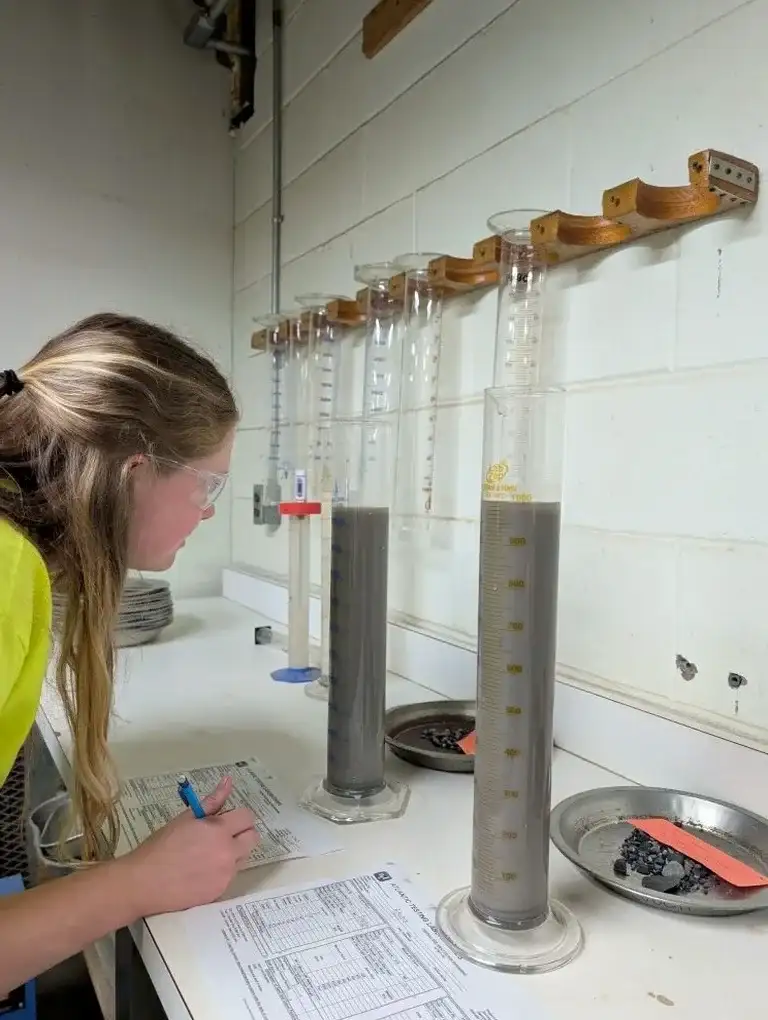
Local geotechnical conditions in Santa Clarita
Santa Clarita's build-out accelerated after the 1994 Northridge earthquake reshaped development patterns across the Santa Clarita Valley. Older industrial parks in Valencia were constructed on cut-fill transitions where the subgrade support varies from decomposed granite to undocumented fill. We've pulled samples from beneath existing asphalt that showed a soaked laboratory CBR of 1.8 percent—barely above expansive clay—while the geotechnical report from the 1980s assumed 10 percent. That mismatch isn't academic; it explains chronic pavement failures in truck yards and bus terminals. The IBC and local municipal code now tie pavement design to geotechnical parameters, and the laboratory CBR test is the most direct way to validate subgrade strength. If you're rehabilitating an old lot or expanding a warehouse, testing a few Shelby tube samples through the suspect zone can prevent under-designed pavement sections that rut within two wet seasons. We run the CBR alongside grain size distribution and plasticity index to build a complete subgrade profile that stands up to Santa Clarita's occasional winter storm cycles.
Our services
Our laboratory CBR program in Santa Clarita covers the full chain from sample receipt to pavement design input. We work with local drilling crews to obtain undisturbed or bulk samples, then tailor the testing matrix to the project's specific subgrade units.
Soaked CBR per AASHTO T 193
Four-day soaked CBR on specimens compacted at Modified Proctor effort. Includes swell measurement during soaking, load-penetration curves, and corrected CBR at 0.1-inch and 0.2-inch penetration.
CBR vs. Moisture Sensitivity Study
We test identical specimens at optimum, wet-of-optimum, and dry-of-optimum moisture to quantify CBR loss under field conditions. Critical for Santa Clarita areas with fluctuating groundwater or irrigation runoff.
Pavement Design Input Package
Combined report delivering soaked CBR, R-value correlation, and resilient modulus (Mr) estimate for use in AASHTO 93 or MEPDG software. Includes subgrade classification per ASTM D2487 and USCS.
Questions and answers
How much does a laboratory CBR test cost in Santa Clarita?
For a single-point soaked CBR test per ASTM D1883, expect to pay between US$140 and US$220. The final cost depends on the number of specimens, whether we need to run a companion Proctor compaction test, and the turnaround time. A full program with three moisture conditions and a Proctor runs higher. Give us a call with your project specs and we'll put together a firm quote.
How long does it take to get CBR results?
A standard soaked CBR requires four days of soaking after compaction, plus sample preparation and testing time. In practice, we typically deliver a complete report within seven to ten business days from sample receipt. If the project is on a tight schedule, we can coordinate with the drilling crew to ship samples overnight and start compaction the same day they arrive.
Can I use a field DCP instead of a laboratory CBR test?
A field DCP gives you a quick profile of penetration resistance, and it's useful for mapping variability across a site. But it doesn't replicate the soaked condition that governs long-term pavement performance. We've correlated DCP data with laboratory CBR on Santa Clarita projects and often see the field value over-predicting soaked strength by 30 to 50 percent. For final pavement design, the laboratory soaked CBR remains the standard of practice per AASHTO and IBC. More info.