The Santa Clarita Valley presents a complex alluvial profile where coarse-grained deposits from the Santa Clara River interleave with fine silts from ancient lakebeds, creating challenging stratigraphy for conventional boreholes. From our lab near the San Gabriel fault zone, we see how these rapid transitions demand continuous data, which is why our team relies on the CPT to capture thin liquefiable layers that SPT spoon samples often miss. In Santa Clarita, where the 1994 Northridge earthquake reminded everyone that deep basin effects amplify shaking, a CPT provides the high-resolution tip resistance and sleeve friction needed for rigorous settlement and lateral spread analysis under current IBC Chapter 18 and ASCE 7-22 requirements. We run the cone truck across Valencia industrial parks, Stevenson Ranch hillsides, and Newhall redevelopment sites, integrating pore pressure dissipation tests into every sounding to refine the groundwater profile for dewatering design.
A continuous 5-mm CPT profile through Santa Clarita alluvium reveals thin silt seams that control liquefaction triggering, seams that a standard SPT would never capture.
Technical details of the service in Santa Clarita
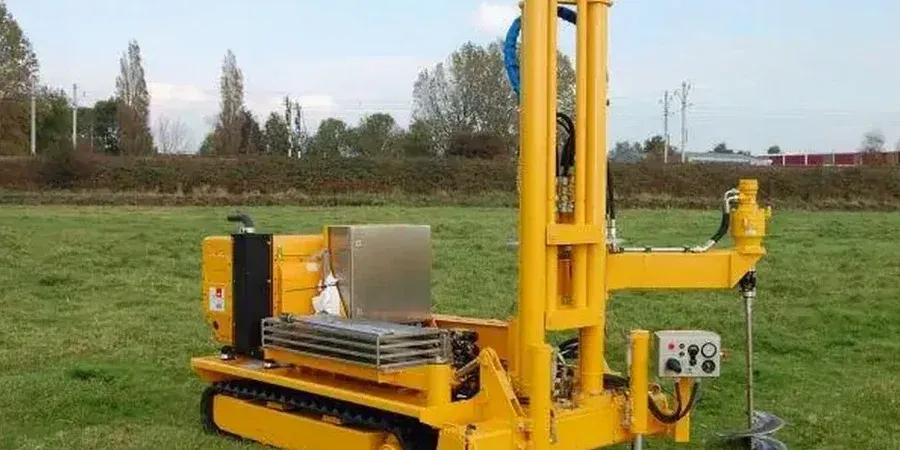
Local geotechnical conditions in Santa Clarita
A four-story mixed-use project on the old Newhall alluvial fan encountered a profile where the CPT tip resistance dropped from 12 MPa to 3 MPa within a 30-centimeter band at 22 feet depth. The contractor had already ordered a mat foundation based on a preliminary SPT logbook that showed N-values around 18 blows per foot across that interval. Our continuous u2 trace showed a sharp pore pressure spike in the same zone, confirming a confined silt layer that would undergo cyclic softening during the design earthquake. Had the team proceeded without the CPT, the differential settlement could have sheared the plumbing risers and cracked the post-tensioned slab within the first five years. In Santa Clarita, where the groundwater table fluctuates seasonally and the river channel shifts course over decades, relying on discrete SPT data alone for liquefaction triggering is a gamble that the ASCE 7 performance-based framework does not support.
Our services
Our Santa Clarita CPT program covers everything from the cone truck mobilization on tight urban lots to the final digital report with corrected parameters ready for PLAXIS or FLAC input.
Seismic Cone Penetration Testing (SCPTu)
Downhole shear wave velocity measurement at 1-meter intervals during CPT pauses, enabling direct Vs,30 calculation for IBC Site Class determination without a separate borehole.
Piezocone Dissipation Testing
Monitored pore pressure decay curves at multiple depths to estimate in-situ hydraulic conductivity in Santa Clarita silty sands, critical for dewatering system design.
Liquefaction Screening per Idriss & Boulanger
Processing of CPT data through Idriss & Boulanger (2014) triggering curves, including fines content correction from Ic, and calculation of LPI for the design earthquake.
CPT-SPT Correlation and Lab Calibration
Side-by-side CPT soundings and SPT borings at select locations, supplemented by grain size and Atterberg limits in our lab, to build a site-specific qc/N60 ratio for the Saugus Formation.
Questions and answers
How much does a CPT sounding cost in Santa Clarita?
A typical CPT sounding in the Santa Clarita Valley ranges from US$180 to US$270 per meter, depending on depth, site access, and whether SCPTu shear wave measurements are included. Mobilization and data reporting are factored into the total proposal.
What depth can the CPT cone reach in the Saugus Formation?
In weathered Saugus Formation sandstone, our 20-ton cone truck typically reaches refusal between 60 and 100 feet, depending on the degree of cementation. We monitor the inclination sensor continuously to stop before rod buckling exceeds the safe bending limit.
Can a CPT replace all SPT borings on a Santa Clarita project?
The CPT provides a continuous profile of soil behavior, but it does not recover a physical sample for index testing. We recommend at least one companion SPT boring per site to calibrate the Ic-based classification against measured grain size and plasticity, ensuring the Robertson correlation is valid for the local alluvium.
Is the CPT suitable for the steep terrain in Canyon Country?
Our CPT truck requires a reasonably level working platform within 5 degrees of horizontal. On steep lots in Canyon Country or Sand Canyon, we often prepare a compacted access bench or, for inaccessible slopes, recommend a seismic refraction survey combined with limited test pits to characterize the near-surface rock.