The Santa Clarita Valley sits on a deep basin of alluvial deposits washed down from the San Gabriel and Santa Susana Mountains. These sediments range from coarse gravels near the Santa Clara River to fine silts and clays on the valley floor. Designing a shallow foundation here without understanding this variability invites differential settlement. The summer heat, often exceeding 100°F, desiccates near-surface clays and triggers shrink-swell cycles that punish under-designed footings. IBC Chapter 18 and ASCE 7-22 require site-specific geotechnical investigation precisely because these conditions change across short distances. A test pit program exposes the stratigraphy directly, letting us observe moisture content and consistency at footing depth instead of relying solely on extrapolated data. That local knowledge feeds directly into bearing capacity calculations, informing whether a conventional isolated footing or a stiffened mat is the prudent choice for the specific lot in Valencia, Canyon Country, or Newhall.
A footing is only as reliable as the soil directly beneath it. In Santa Clarita, that soil can change from gravel to expansive clay within 100 feet.
Technical details of the service in Santa Clarita
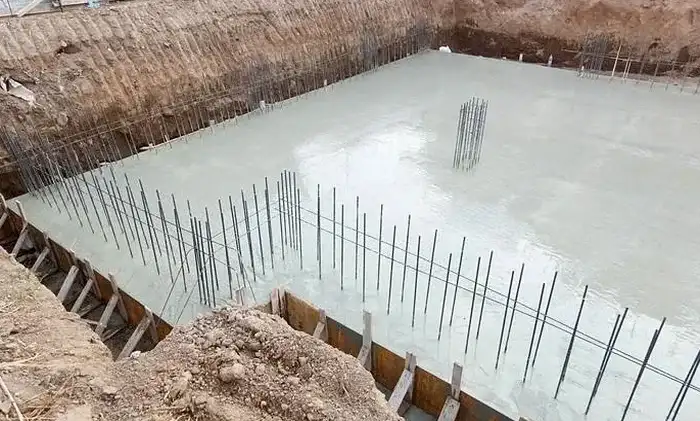
Local geotechnical conditions in Santa Clarita
ASCE 7-22 Section 11.8 requires explicit evaluation of liquefaction and cyclic softening for Seismic Design Category D, which covers much of Santa Clarita. The loose alluvial sands and silts along the Santa Clara River corridor can lose strength during a major event on the San Andreas or Sierra Madre fault systems. A shallow foundation design that neglects this risk may expertise sudden bearing failure, not just settlement. The IBC prohibits supporting footings on soils vulnerable to strength loss unless mitigated. Where we identify liquefiable layers within the bearing zone, the design must either deepen the foundation to competent stratum, switch to a mat foundation to bridge soft spots, or specify ground improvement. Post-seismic total settlement and angular distortion between columns become the controlling limit states, not static service loads.
Our services
Our shallow foundation design scope extends from feasibility analysis through construction observation. Every project receives a site-specific bearing capacity and settlement report sealed by a California-licensed geotechnical engineer. We coordinate with the structural engineer of record to optimize footing geometry and reinforcement.
Bearing Capacity Analysis
Determination of net allowable soil bearing pressure under strength-level and service-level load combinations, including depth and width corrections per accepted geotechnical methods.
Settlement Evaluation
Immediate and consolidation settlement calculations using Schmertmann, Hough, and consolidation theory, with recommendations for tolerable differential movement between adjacent footings.
Expansive Soil Mitigation Design
Prescriptive measures for Type I and Type II expansive soils including moisture barrier systems, select fill under slabs, and deepened perimeter footings per CBC requirements.
Questions and answers
What is the typical cost range for a shallow foundation design report in Santa Clarita?
For a single-family residential lot, the geotechnical investigation and shallow foundation design report typically falls between US$2,020 and US$3,340. The final fee depends on lot access, number of exploratory borings required, and whether laboratory testing for expansion index or consolidation is necessary.
How deep should footings be in Santa Clarita to avoid expansive soil damage?
The minimum embedment is 18 inches below exterior finished grade, but this increases to 30 inches where high-plasticity clays are present. The exact depth is set to get below the zone of seasonal moisture fluctuation. We also often specify a capillary break of clean sand or gravel beneath the slab.
Does a shallow foundation need a seismic design check in Santa Clarita?
Yes. The IBC and ASCE 7 require checking the bearing capacity under seismic load combinations. The allowable soil pressure can be increased by one-third for transient seismic loads, but the soil must also be evaluated for strength loss due to cyclic loading, especially in saturated granular soils near the river.
Can you design a shallow foundation on fill soils?
It is possible, but only if the fill is engineered and documented. For undocumented fill, we usually recommend extending the footing through the fill to competent native soil, or conducting in-place density testing and settlement analysis to verify the fill can support the load without excessive settlement. More info.