In Santa Clarita, the soil profile rarely tells a simple story. One project in Valencia might hit clean alluvial sands from the Santa Clara River, while another in Canyon Country exposes fine-grained colluvium that behaves completely differently under load. The grain size analysis fills the gap between field observation and engineering design. By running the full sieve stack alongside a hydrometer, we map the complete gradation curve from coarse gravel down to clay-sized particles. This data directly feeds into drainage design, frost heave risk, and bearing capacity calculations. For local contractors dealing with the mix of decomposed granite and sedimentary soils common in the Santa Clarita Valley, we often pair this test with Atterberg limits to confirm the plasticity characteristics that grain size alone cannot reveal.
A complete grain size curve is the first step in classifying a soil correctly, and in Santa Clarita's mixed alluvial deposits, skipping the hydrometer means missing the story the fines are trying to tell.
Technical details of the service in Santa Clarita
Local geotechnical conditions in Santa Clarita
The hydrometer side of the test demands patience. We start with a 50-gram specimen of minus-#40 material, mix it with a dispersing agent, and place it in a 1,000-mL sedimentation cylinder inside a constant-temperature water bath. Temperature control is critical in Santa Clarita, where summer lab temperatures can swing past 90 degrees Fahrenheit if the HVAC isn't dialed in. A two-degree drift changes the fluid viscosity enough to throw off the readings. We take hydrometer measurements at 2, 5, 15, 30, 60, 250, and 1,440 minutes, plotting the percent finer against grain diameter on a semi-log scale. The most common failure we catch is incomplete dispersion of clay aggregates, which leads to an overestimation of silt content and a misclassification that can cause a contractor to select the wrong filter fabric or underestimate consolidation settlement.
Our services
Our Santa Clarita geotechnical lab supports the full workflow from field sampling to final report. These operations work together to build a complete picture of subsurface conditions.
Sieve Analysis Package
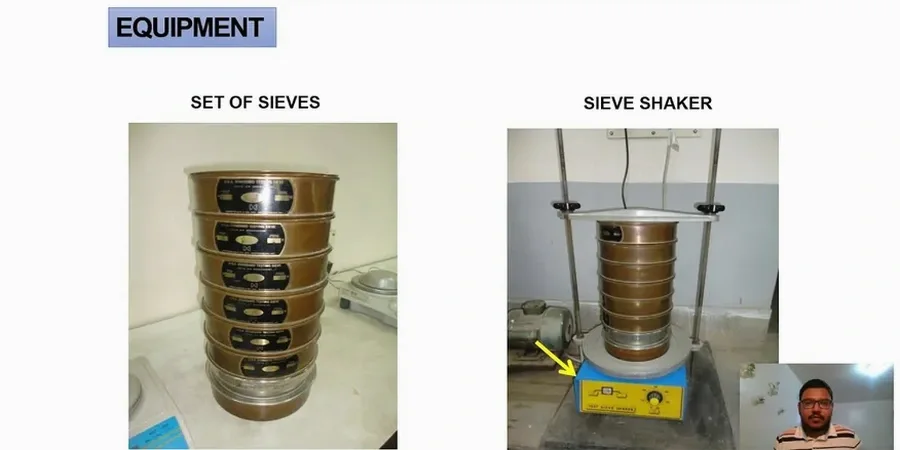
Wash and dry sieving from 3-inch gravel down to the #200 sieve. We carry out the percent retained on each sieve, total percent passing, and a plotted gradation curve with D-values and uniformity coefficients.
Hydrometer Sedimentation Test
Full ASTM D7928 hydrometer analysis with dispersing agent optimization for Santa Clarita's iron-rich residual soils. Includes temperature-corrected readings and a merged gradation report with the sieve data.
Combined Gradation and Classification Report
A single integrated report merging sieve and hydrometer data, assigning USCS group symbol and group name per ASTM D2487, with commentary on the engineering implications for your specific project.
Questions and answers
What is the cost of a grain size analysis with hydrometer in Santa Clarita?
For projects in the Santa Clarita area, a combined sieve and hydrometer analysis typically ranges from US$100 to US$210 per sample. The exact cost depends on the number of samples and whether the material is predominantly coarse or fine-grained. We carry out a firm quote after reviewing the project specifications.
How much sample material do you need for a full gradation test?
It depends on the maximum particle size. For soils with gravel up to 3/4 inch, about 500 grams of dry material is sufficient. If the soil contains cobbles or larger gravel, we may need up to 15 kilograms to run the full coarse sieve stack without sub-sampling errors.
Why do I need the hydrometer if I already have a sieve analysis?
The sieve analysis stops at the #200 sieve (0.075 mm). Anything passing that sieve is just reported as 'percent fines.' The hydrometer separates that fraction into silt and clay sizes, which is essential for classifying the soil correctly under the Unified Soil Classification System and for predicting drainage, frost susceptibility, and compressibility.
Can you run the test on samples from a test pit or only from drill rigs?
We can run grain size analysis on disturbed samples from any source. Whether the sample comes from an SPT split spoon, a test pit excavation, or a hand auger, as long as the bagged sample is representative and properly sealed, the test procedure is the same.
How long does a combined sieve and hydrometer test take?
The sieve portion can be completed in one working day. The hydrometer analysis requires a minimum of 24 hours of sedimentation readings, plus drying and data reduction time. A typical turnaround for a combined report with classification is 3 to 4 business days from sample receipt, though we can expedite for urgent projects. More info.