One of the most frequent — and costly — callbacks we see in Santa Clarita comes from contractors who assumed a few passes with a smooth-drum roller were enough. The soil looks firm, the operator signs off, and six months later a foundation slab shows hairline cracks that trace back to 88% compaction where the spec required 95. The sand cone test is still the direct, defensible field check that catches under-compacted lifts before they become structural problems. In a city where summer temperatures routinely exceed 100°F and moisture evaporates fast from exposed fill, the window for hitting optimum moisture is narrow. We run ASTM D1556 density tests on pads, utility backfill, and aggregate base across the Santa Clarita Valley — from Canyon Country to Newhall — because the mix of alluvial deposits and engineered fill here doesn’t forgive shortcuts. For projects where deep fill is placed on slopes, combining compaction verification with a slope stability assessment helps avoid differential settlement at the bench interface.
In Santa Clarita, a passing density test isn’t about luck — it’s about matching the right Proctor curve to the right lift before the heat sets the moisture.
Technical details of the service in Santa Clarita
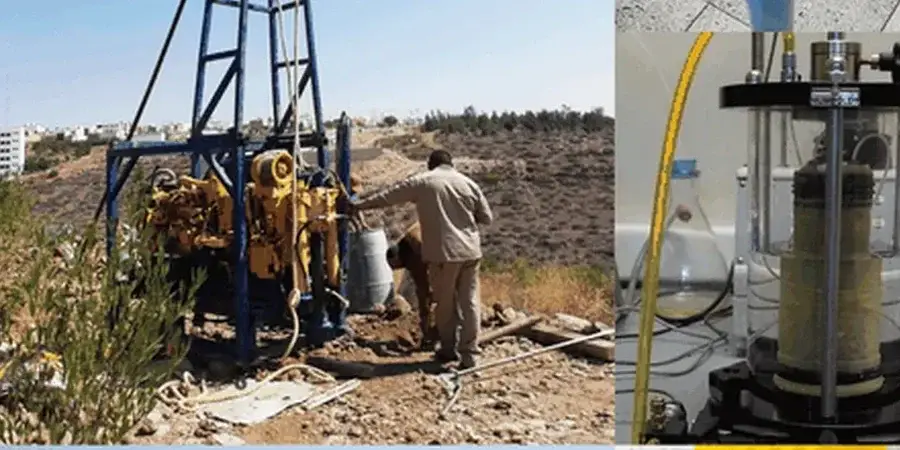
Local geotechnical conditions in Santa Clarita
We were called to a commercial site off Rye Canyon Road where a retaining wall backfill had been placed in 18-inch loose lifts — double what the geotechnical report allowed. The contractor had already poured the wall stem and was preparing the parking lot subgrade. Three sand cone tests taken at mid-lift depth came back between 84 and 87 percent of modified Proctor, well below the 92 percent minimum for wall backfill. The owner faced a difficult choice: remove the wall and re-compact, or accept a long-term settlement risk that would crack the pavement within two years. They chose to rework the zone. The lesson that stuck with the project team was that density testing isn’t a formality — it’s the only objective check between a buried defect and a signed-off lift. In Santa Clarita, where post-wildfire debris basins and graded pads intersect, a failed density test caught early saves tens of thousands in remedial grouting or slab replacement down the line. We also see projects near old alluvial channels where loose lenses survive standard compaction — these pockets show up immediately in a sand cone test but can be completely invisible to proof-rolling.
Our services
Our field density program in Santa Clarita covers the full compaction-control workflow from lab Proctor to final acceptance — all managed by the same technical team to avoid data gaps between the laboratory and the field crew.
Standard Proctor (ASTM D698) and Modified Proctor (ASTM D1557)
We establish the reference maximum dry density and optimum moisture content on your borrow material before a single lift is placed, using the compactive effort specified in the project geotechnical report.
Sand Cone Field Density Testing (ASTM D1556)
Point-by-point verification on pads, utility trenches, aggregate base, and retaining wall backfill across Santa Clarita, with same-day dry density and percent compaction reports.
Nuclear Gauge Correlation and Spot Checks
We calibrate nuclear density gauges against sand cone results to speed up production testing on large subdivisions while maintaining ASTM D1556 as the referee method.
Compaction Troubleshooting and Rework Verification
When a lift fails, we help the earthwork contractor diagnose the cause — moisture control, lift thickness, or material variability — and retest after recompaction to close the non-conformance.
Questions and answers
What is the typical cost of a sand cone density test in Santa Clarita?
For projects within the Santa Clarita Valley, field density testing by the sand cone method typically ranges from US$100 to US$140 per test point, depending on the number of tests per mobilization, site accessibility, and whether a companion Proctor curve is already on file. We carry out a firm quote based on the expected test count and travel distance from our local staging area.
How does ASTM D1556 compare to nuclear gauge testing?
The sand cone method is a direct volume-based measurement that doesn’t rely on calibration to site-specific soil chemistry, so it’s the preferred referee method when nuclear gauge results are in dispute or when the material contains elevated iron or organic content. Nuclear gauges are faster for production testing, but most specs in Santa Clarita require a minimum number of sand cone correlations at the start of each project.
What moisture condition is acceptable for compaction in Santa Clarita?
Most structural fill specs require the material to be within ±2 percent of its optimum moisture content determined by the Proctor curve. During Santa Clarita’s dry summer months, we frequently see fill that has dried below the acceptable window, requiring water addition and re-mixing before compaction and density testing can proceed.
How many sand cone tests are required per lift?
The frequency is specified in the project geotechnical report, but a common rule of thumb for building pads in Santa Clarita is one test per 2,500 square feet of placed lift, with a minimum of three tests per lift when the area is small. Utility trenches typically require a test every 50 linear feet per lift. We work to the approved testing schedule and can add spot checks if visual observation suggests a problem zone.
Can a sand cone test be performed on aggregate base for pavement?
Yes, ASTM D1556 is regularly used on aggregate base course, provided the maximum particle size doesn’t exceed about 2 inches. For pavement sections in Santa Clarita, the base is typically compacted to 95 percent of modified Proctor density, and we verify each lift before the asphalt or concrete cap is placed.