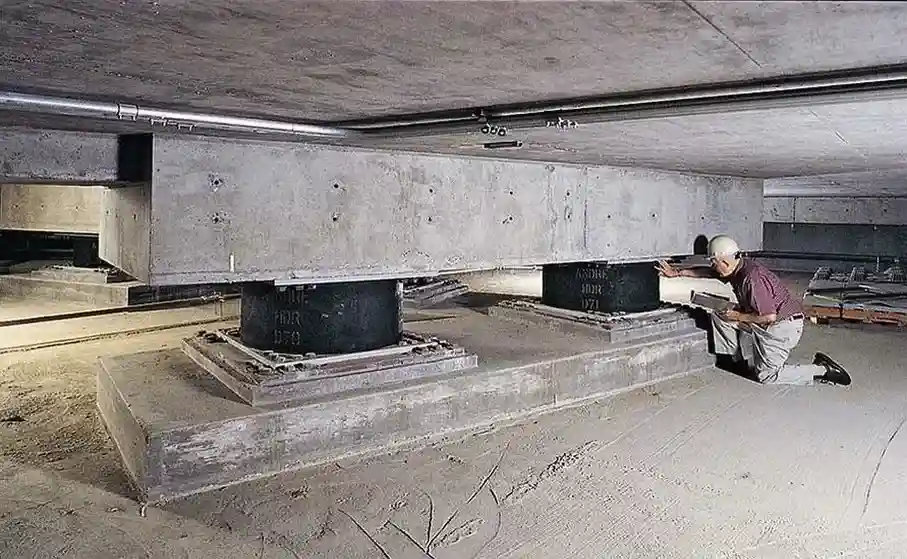
The difference in ground behavior between a hillside home in Valencia and a commercial building on the old floodplain near the Santa Clara River is night and day. In Santa Clarita, we are not just dealing with one soil type; we have ancient alluvium, young stream deposits, and weathered bedrock within a few miles of each other. This variation, combined with the city's proximity to the San Gabriel and San Andreas fault systems, makes a standard fixed-base design a gamble. A base isolation design decouples the structure from the most violent ground shaking, allowing the building to move gently on elastomeric or sliding bearings rather than fighting the earthquake. In our expertise, the performance difference in a major seismic event on sites with deep cohesionless soil is the margin between a reparable structure and a total loss. We often recommend pairing this analysis with a site-specific liquefaction assessment to verify that the bearing stratum under the isolators will remain stable during a maximum considered earthquake.
An isolated structure in Santa Clarita can reduce spectral acceleration demands by up to 70 percent compared to a fixed-base design in the same near-fault zone.
Technical details of the service in Santa Clarita
Local geotechnical conditions in Santa Clarita
One thing we see repeatedly in Santa Clarita is the misapplication of standard spectral ordinates without accounting for near-fault forward directivity. The city sits less than 15 kilometers from mapped active traces of the San Gabriel fault, which introduces a velocity pulse that is devastating to mid-rise fixed-base buildings. If you ignore the near-source factors in ASCE 7 Chapter 11 and assume a simple Site Class D profile, you can underestimate the isolator displacement by thirty percent or more. Another local pitfall is the presence of undocumented fill from the master-planned community expansions of the 1990s. We have encountered loose fill extending twenty feet deep on what the county GIS maps label as competent Saugus Formation. Placing isolation bearings over undocumented fill without dynamic soil-structure interaction analysis risks differential settlement that renders the isolation plane useless during the shaking.
Our services
We carry out full-spectrum base isolation engineering operations that go beyond the bearing design itself. The goal is always a complete structural isolation package that coordinates with the local geotechnical data and the architect's performance objectives.
Nonlinear Time-History Analysis
We generate site-specific spectrally matched ground motion suites for Santa Clarita, accounting for directivity and basin edge effects from the San Gabriel Mountains. Our models capture the hysteretic behavior of the isolation system explicitly.
Isolation System Peer Review
For design-build teams or contractors working on public projects in the city, we carry out independent verification of bearing properties, prototype test reports, and displacement compatibility with the surrounding moat wall.
Questions and answers
Does base isolation work for light-frame wood construction common in Santa Clarita neighborhoods like Newhall?
Base isolation is not typically cost-effective for light-frame single-family homes because the superstructure mass is too low to engage the bearings efficiently. The system works best for buildings over three stories or essential facilities with high seismic performance requirements.
What is the expected cost range for a base isolation design package on a mid-rise project in Santa Clarita?
For a standard mid-rise structure, the full design package including nonlinear time-history analysis, bearing specification, and special inspection support typically falls between US$4,090 and US$9,550 depending on the complexity of the ground motion modeling and the number of isolator units.
How do you handle the moat wall detail in a tight urban lot in downtown Santa Clarita?
In confined sites, we design a cantilevered moat wall that doubles as a retaining structure. The displacement gap is verified against MCE demands, and we use compressible void material to prevent soil intrusion. The cover plate detail is critical for pedestrian safety and must accommodate the full D_M displacement without binding.
What testing is required for the isolators before installation?
ISO 22762 governs the testing. We require prototype testing of two full-scale units to verify horizontal stiffness, damping, and stability under combined vertical load and lateral displacement. Production testing then confirms that each manufactured bearing matches the prototype properties within acceptable tolerances.
How does the Santa Clarita groundwater table affect isolation system design?
In areas near the Santa Clara River, groundwater can be within 20 feet of the surface. The lower isolation interface must be waterproofed, and the bearings must be protected from corrosion. We often specify a recessed isolation pit with a drainage system to keep the isolators dry and accessible for inspection over the building's lifespan.