Ground conditions in Santa Clarita change fast from one parcel to the next. A lot in Valencia sits on dense Pleistocene Saugus Formation, but drive five miles east toward Canyon Country and you hit loose Holocene alluvium from the Santa Clara River wash. That difference dictates foundation cost and seismic risk. Our lab runs on-site CPT soundings and grain-size curves before any vibrocompaction grid is laid out. We match probe spacing, vibration frequency, and duration to the gradation envelope we actually measure, not to a textbook table. For sites where the upper 15 ft are clean sands with less than 10% fines, we often validate densification with in-situ permeability tests to confirm vertical drainage paths remain open after treatment.
We design each vibrocompaction grid from measured gradation and CPT data, so the post-treatment bearing capacity is verifiable down to the design depth.
Technical details of the service in Santa Clarita
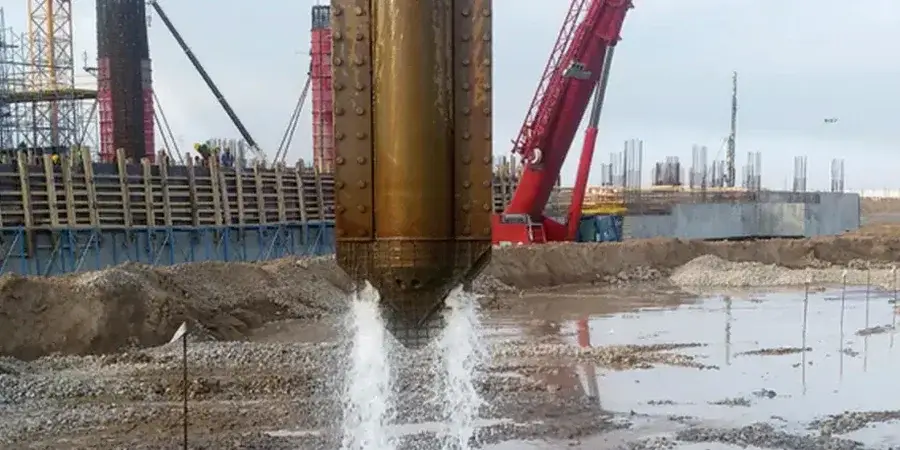
Local geotechnical conditions in Santa Clarita
The Santa Clara River Valley has a mapped groundwater basin with shallow water tables in winter, but much of Santa Clarita's developable land sits on older terrace deposits where water is deep. The real risk is unrecorded fill. Decades of grading in Santa Clarita left pockets of loose sandy fill that were never engineered. A standard footing excavation won't reveal the problem until settlement cracks appear. Vibrocompaction design in these zones requires a tighter probe grid and multiple passes, verified with post-densification SPT borings. Seismic demand under ASCE 7-22 for Site Class D default puts extra pressure on differential settlement control. We design the grid to bring the site to Site Class C where possible, reducing the seismic coefficient for the structural engineer.
Our services
We cover three stages of vibrocompaction work in Santa Clarita. Each stage has a defined deliverable tied to a specific ASTM standard or IBC acceptance criterion.
Pre-Treatment Site Characterization
We drill SPT borings and push CPT soundings on a 50-ft grid. Samples go through full mechanical sieve analysis per ASTM D6913. The lab report includes a liquefaction susceptibility screening for the design earthquake.
Vibrocompaction Grid Design
Based on gradation and target relative density (typically 70-85%), we specify probe diameter, spacing pattern, amperage targets, and number of passes. The deliverable is a signed, stamped design package ready for the grading contractor.
Post-Treatment QA/QC Verification
We return with the CPT rig and test at centroid locations between probes. The report compares pre- and post-treatment tip resistance, sleeve friction, and estimated relative density. We issue a letter of compliance when specifications are met.
Questions and answers
What soil types in Santa Clarita respond best to vibrocompaction?
Clean sands (SP) and silty sands (SP-SM) with fines content below 15 percent. Much of the Santa Clara River alluvium fits this profile. Soils with more than 20 percent fines require a different approach, usually stone columns.
How long does a typical vibrocompaction design and verification program take?
Site characterization takes 2-3 days. Design and report writing takes 5-7 business days. The compaction contractor's timeline is separate. Our post-treatment verification usually takes 1-2 days.
What does vibrocompaction design cost for a Santa Clarita residential lot?
For a standard single-family residential lot in Santa Clarita, the full design and QA/QC package typically ranges from US$1,540 to US$5,430, depending on lot size, number of probes, and verification boreholes required.
Is vibrocompaction design accepted by the City of Santa Clarita Building & Safety Division?
Yes. We carry out a stamped design package and post-treatment verification letter that meets IBC Chapter 18 and the City's grading ordinance requirements. The reports are formatted for direct submittal to plan check.